
Airport transportation changes significantly when travel involves more than one passenger and more than one suitcase. For families traveling to Vancouver International Airport, transportation decisions must account for coordination, physical handling, timing precision, and passenger readiness before arrival at the terminal. These factors shape how different transportation models perform under real-world conditions.
The Complexity of Group Based Airport Travel
Family travel introduces interdependencies that do not exist in individual transportation scenarios. Every passenger must arrive together, baggage must be transported safely, and disruptions affect the entire group simultaneously. Unlike solo travelers, families cannot easily adapt to last-minute changes without increasing stress or delay.
From a transportation planning standpoint, this makes family airport travel a coordination-driven activity rather than a simple ride.
Physical Handling as a Transportation Factor
Managing Luggage Movement From Origin to Terminal
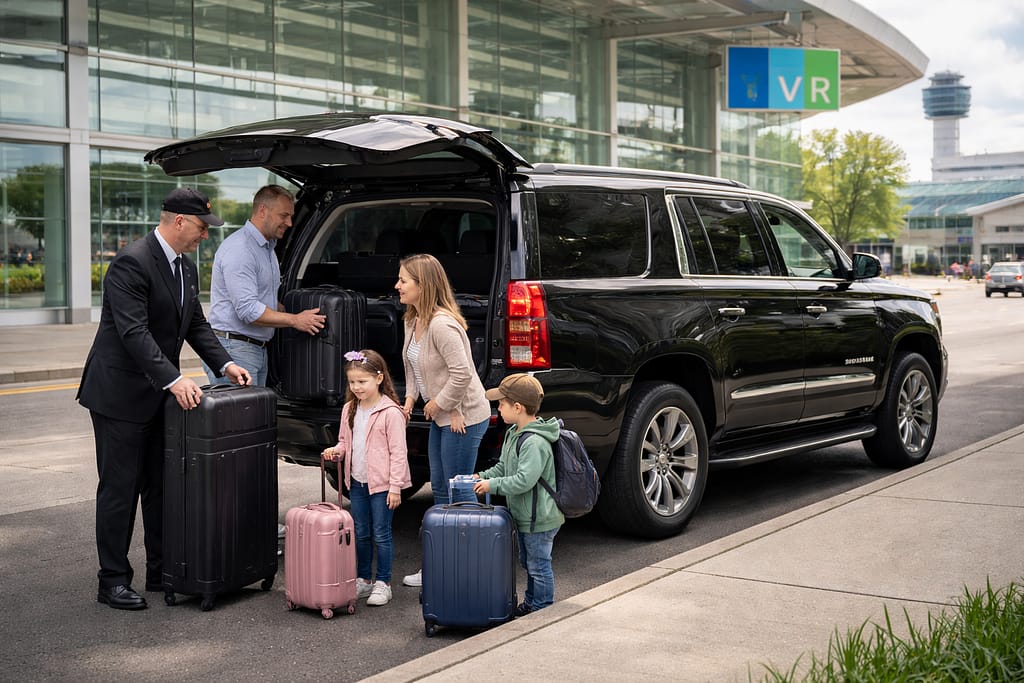
Luggage handling is often underestimated in transportation planning. Families frequently travel with large suitcases, carry-on bags, strollers, and child-related equipment. Each item requires space, stability, and secure placement during transit.
Private airport transfers treat luggage movement as part of the transportation process rather than an afterthought, ensuring that loading and unloading are handled within a controlled environment.
Reducing Repacking and Vehicle Constraints
Transportation formats with limited cargo capacity may require repacking, splitting items between vehicles, or leaving belongings behind temporarily. These situations increase stress and extend preparation time.
Private transfers are structured to accommodate total travel volume in one vehicle, reducing physical and logistical fragmentation.
Timing Reliability Before Departure
Departure Windows Rather Than Fixed Pickup Times
Airport travel is governed by airline check-in deadlines rather than transportation availability. Private airport transfers are scheduled backward from required terminal arrival times, factoring in traffic conditions and route variability.
This approach prioritizes arrival readiness over adherence to rigid pickup schedules.
Predictability During Peak Travel Hours
Traffic patterns leading to YVR fluctuate based on time of day, season, and terminal congestion. Transportation planning for families often includes earlier departure buffers to account for these variables.
Private transfers allow for this buffer planning without introducing additional stops or delays.
Passenger Readiness and Pre Flight Conditions
Travel Comfort as a Functional Requirement
Before long flights, passenger comfort affects readiness and energy levels. Families traveling with children benefit from stable seating, climate control, and uninterrupted travel that allows passengers to remain settled.
Private vehicles support this environment by minimizing movement and disruptions during the drive.
Maintaining Group Focus
When transportation involves multiple vehicles or transfers, attention is divided between coordination and movement. A single private transfer allows families to remain focused on preparation rather than logistics.
This continuity supports calmer pre-flight conditions.
Airport Interface and Arrival Dynamics at YVR
Terminal Access and Drop Off Flow
YVR’s terminal layout requires efficient curbside interaction, especially during busy departure periods. Families arriving with luggage benefit from direct access points that reduce walking distance and streamline unloading.
Private airport transfers support this by aligning vehicle arrival with terminal flow rather than secondary pickup zones.
Transition From Vehicle to Check In
The moment of arrival is often the most physically demanding stage of family airport travel. Coordinated unloading and proximity to terminal entrances reduce friction at this stage.
Transportation formats that prioritize this transition contribute to smoother airport entry.
Situations Where Private Transfers Are Commonly Used
From an industry observation standpoint, private airport transfers are frequently used when:
- Multiple passengers must arrive simultaneously
- Luggage volume exceeds standard vehicle capacity
- Travel involves children or elderly family members
- Departure timing leaves little margin for delay
These conditions emphasize coordination rather than flexibility.
Transportation as a Support System
Rather than serving only as a means of travel, airport transportation for families functions as a support system that bridges home and terminal readiness. The structure of private airport transfers reflects this role by integrating capacity planning, timing alignment, and physical handling into one continuous process.