
Luggage volume is one of the most underestimated variables in airport transportation planning. In Vancouver, where airport travel often involves international flights, seasonal tourism, cruise connections, and long-haul itineraries, the amount and type of luggage passengers carry directly affects which vehicles can support a smooth and predictable transfer to YVR.
Professional transportation planning treats luggage volume as a primary input rather than a secondary consideration.
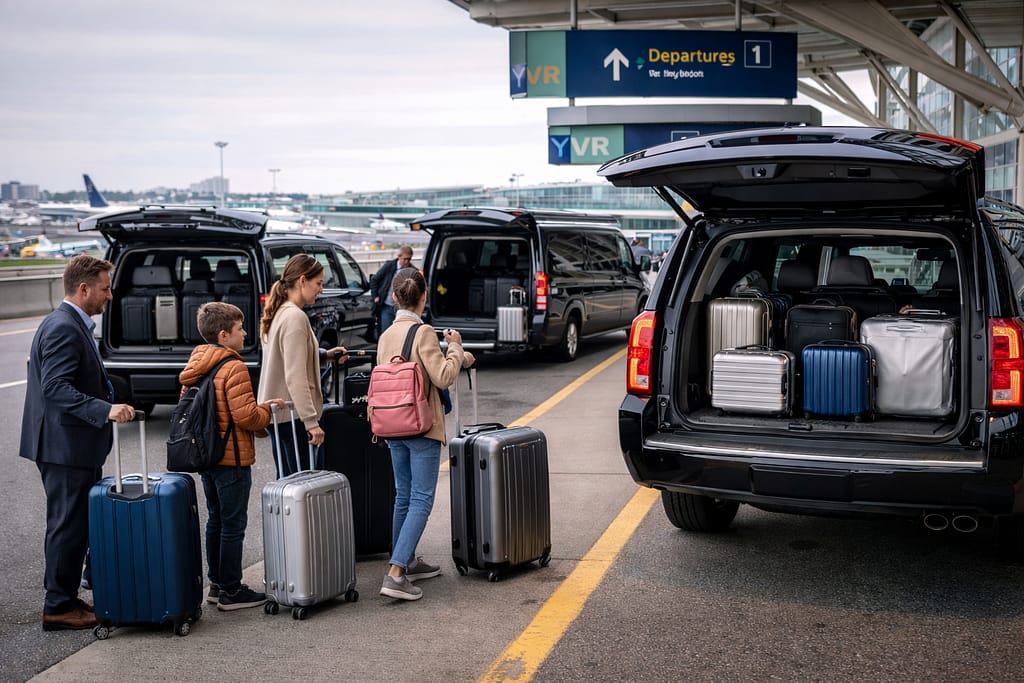
Luggage as a Load Management Factor
From an operational standpoint, luggage is not simply stored cargo. It is part of the vehicle’s total load, influencing weight distribution, interior configuration, and ride stability. When luggage volume exceeds what a vehicle is designed to accommodate comfortably, travel efficiency and passenger experience degrade simultaneously.
Effective vehicle selection begins by understanding how luggage interacts with vehicle capacity rather than assuming all airport trips are similar.
Typical Luggage Profiles for Vancouver Airport Travel
Airport travel in Vancouver produces a wide range of luggage profiles, including:
- International travelers with multiple checked bags
- Families traveling with suitcases, strollers, and carry-ons
- Cruise passengers with extended-stay luggage
- Business travelers carrying presentation materials or equipment
- Seasonal travelers with sports or outdoor gear
Each profile places different demands on vehicle interior space and cargo access.
Cargo Capacity Versus Usable Space
Total Capacity Is Not the Same as Practical Capacity
Manufacturers may advertise large cargo volumes, but usable space depends on seating configuration, passenger count, and luggage shape. A vehicle that technically fits luggage may still require stacking or compression that limits comfort and accessibility.
Professional planning evaluates usable cargo space with passengers seated, not theoretical maximums with seats folded.
Shape and Accessibility of Storage Areas
Suitcases, garment bags, and specialty items vary in shape and rigidity. Vehicles with flat cargo floors and wide openings allow for organized placement, reducing shifting during transit and simplifying loading and unloading at YVR.
Narrow or irregular cargo areas increase handling time and instability.
Passenger Comfort and Interior Balance
Avoiding Encroachment Into Passenger Space
When luggage volume exceeds cargo capacity, bags are often placed within the passenger cabin. This reduces legroom, restricts movement, and increases fatigue before flights.
Vehicle selection prioritizes preserving passenger space regardless of luggage volume.
Maintaining Weight Balance for Ride Stability
Uneven or overloaded cargo placement affects braking, acceleration, and cornering behavior. Over longer airport routes or during highway travel, this imbalance becomes more pronounced.
Balanced load distribution contributes to smoother, more predictable travel.
Airport Timing and Luggage Handling Efficiency
Loading and Unloading Time as a Scheduling Variable
High luggage volume increases curbside dwell time at pickup and drop-off locations. Vehicle selection influences how quickly luggage can be loaded and removed without reorganization or repacking.
Efficient handling reduces delays during busy departure windows at YVR.
Minimizing Rehandling During Transfers
Vehicles that require luggage to be rearranged mid-trip or during unloading increase the risk of delays and damage. Professional planning favors vehicles that support one-time loading and unloading.
This reduces friction at both ends of the journey.
Vehicle Categories and Luggage Suitability
Full-Size SUVs for Moderate to High Luggage Volume
Full-size SUVs offer a balance between passenger comfort and cargo capacity. They are well-suited for small groups with multiple suitcases while maintaining ride stability and highway performance.
These vehicles support airport travel where luggage volume is significant but not extreme.
Passenger Vans for High-Volume or Group Travel
For larger groups or travelers with extensive luggage, professional vans provide expanded cargo space without compromising seating comfort. This configuration avoids stacking and maintains clear walkways inside the vehicle.
Vans are often selected for cruise transfers, family travel, and group airport departures.
Weather and Environmental Considerations
Secure Storage During Adverse Conditions
Rain is common in Vancouver, and luggage exposure during loading and unloading becomes a concern. Vehicles with enclosed rear access reduce exposure time and protect belongings during transfers.
Covered loading areas and rear lift gates improve reliability under wet conditions.
Seasonal Equipment and Specialty Items
Winter sports equipment or oversized items require additional planning. Vehicle selection accounts for non-standard luggage dimensions that cannot be accommodated through compression.
Ignoring these items leads to last-minute adjustments that disrupt schedules.
Luggage Volume as a Predictability Driver
Luggage volume directly influences:
- Vehicle assignment accuracy
- Loading and unloading duration
- Interior comfort
- Ride stability
- Arrival timing consistency
When luggage is planned for correctly, transportation operates as a controlled process rather than a reactive one.
Vehicle Selection as an Extension of Trip Planning
In professional airport transportation, selecting the right vehicle is not about appearance or preference. It is about aligning physical capacity with travel requirements. Luggage volume acts as a constraint that shapes which vehicles can deliver predictable outcomes without compromising comfort or timing.
For airport travel in Vancouver, especially to and from YVR, understanding how luggage volume influences vehicle selection allows transportation planning to absorb complexity rather than be disrupted by it.