
Cruise Day as a High Constraint Travel Environment
From a transportation planning perspective, cruise embarkation day differs significantly from routine travel. Cruise ships operate on immovable departure schedules, terminal access is regulated, and passenger processing occurs in concentrated timeframes. Unlike flights, cruise departures do not accommodate late arrivals.
These constraints mean transportation reliability is measured not by convenience, but by consistency and timing accuracy.
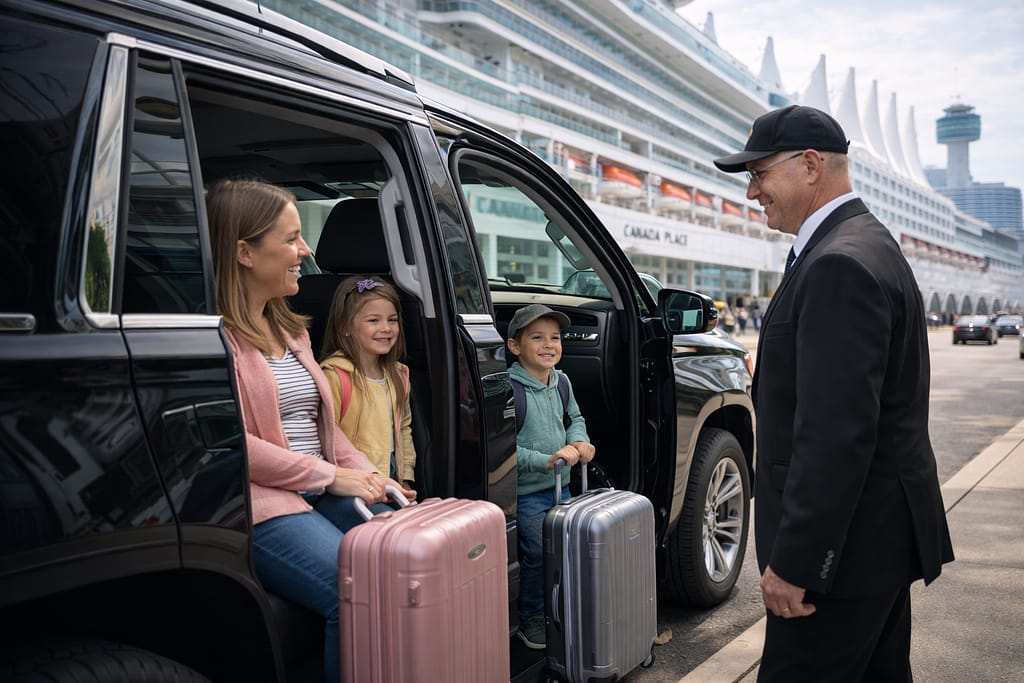
The Impact of Passenger Volume and Terminal Congestion
Concentrated Arrival Windows
On cruise days, thousands of passengers arrive at Vancouver’s cruise terminals within overlapping time blocks. This concentration places strain on surrounding roads, curbside access zones, and staging areas.
Transportation systems that rely on flexible availability struggle under these conditions. Chauffeur services, by contrast, operate on predetermined schedules designed around terminal flow patterns.
Limited Margin for Recovery
Once traffic congestion or terminal delays occur, opportunities to recover lost time are minimal. Missed curbside windows or delayed drop-offs can cascade into longer wait times or boarding complications.
Professional transportation planning accounts for these limitations through early arrivals and controlled routing.
Luggage Handling as a Stress Variable
Volume and Mobility Challenges
Cruise passengers often travel with significantly more luggage than air travelers. Multiple suitcases per passenger, along with carry-ons and specialty items, increase physical handling demands at every stage of the journey.
Chauffeur services integrate luggage handling into the transportation process, reducing the physical and cognitive load on passengers during arrival.
Single Vehicle Continuity
Managing luggage across multiple vehicles or transfers introduces fragmentation and increases the risk of delays or misplaced items. A single chauffeur-driven vehicle maintains continuity from pickup location to terminal curbside.
This continuity simplifies both logistics and passenger focus.
Time Coordination Beyond Departure Schedules
Boarding Windows and Terminal Processing
Cruise lines assign boarding windows to manage passenger flow through security and check-in. Transportation timing must align not only with ship departure but also with these assigned windows.
Chauffeur services schedule pickups backward from boarding requirements, incorporating buffer time for traffic and terminal access rather than relying on static departure estimates.
Traffic Variability Around Canada Place
The downtown Vancouver area surrounding Canada Place experiences variable traffic influenced by port operations, events, and urban congestion. Chauffeur services account for these patterns through route planning and real-time adjustments.
This adaptability supports more predictable arrival timing on high-demand cruise days.
Psychological Load and Travel Readiness
Reducing Decision Fatigue
Cruise day involves numerous decisions related to documents, luggage, timing, and boarding procedures. Transportation that requires additional coordination or improvisation increases cognitive strain.
Chauffeur services remove transportation-related decisions from the passenger’s responsibility, allowing focus to remain on cruise preparation.
Maintaining Group Cohesion
Families and groups benefit from unified transportation that keeps all travelers together. Fragmented arrivals increase stress and complicate check-in processes at the terminal.
Chauffeur service supports group cohesion by coordinating arrival as a single movement.
The Role of Professional Oversight
Advance Planning Rather Than Reactive Travel
Chauffeur services operate on advance reservations with documented pickup times, destinations, and passenger details. This planning framework reduces reliance on real-time availability during peak cruise hours.
From an industry perspective, advance planning is the primary factor in stress reduction.
Chauffeur Familiarity With Cruise Operations
Drivers experienced in cruise day transportation understand terminal layouts, curbside procedures, and staging expectations. This familiarity reduces confusion at arrival points and supports smoother drop-offs.
Common Scenarios Where Stress Is Reduced
Chauffeur services are frequently used on cruise day when:
- Travel involves large luggage volumes
- Passengers are unfamiliar with Vancouver traffic patterns
- Boarding windows leave little margin for delay
- Groups or families must arrive together
- Travel occurs during peak cruise season
These conditions prioritize coordination and predictability.
Transportation as a Stabilizing Element on Cruise Day
In the broader context of cruise travel, transportation serves as the final controllable variable before embarkation. When transportation is structured and predictable, passengers arrive at the terminal prepared and on schedule, reducing the likelihood of downstream complications.
Chauffeur services contribute to this stability by transforming ground transportation into a managed process rather than an uncertain step.